upload/alexandrina/6. Middle Ages Series/Toronto Italian Studies/Sherry Roush - Speaking Spirits. Ventriloquizing the Dead in Renaissance Italy (Toronto Italian Studies) (2015) [Retail].epub
Speaking Spirits: Ventriloquizing the Dead in Renaissance Italy (Toronto Italian Studies) 🔍
Sherry Roush
University of Toronto Press, University of Toronto Press, Toronto, 2015
English [en] · EPUB · 4.3MB · 2015 · 📘 Book (non-fiction) · 🚀/lgli/lgrs/upload · Save
description
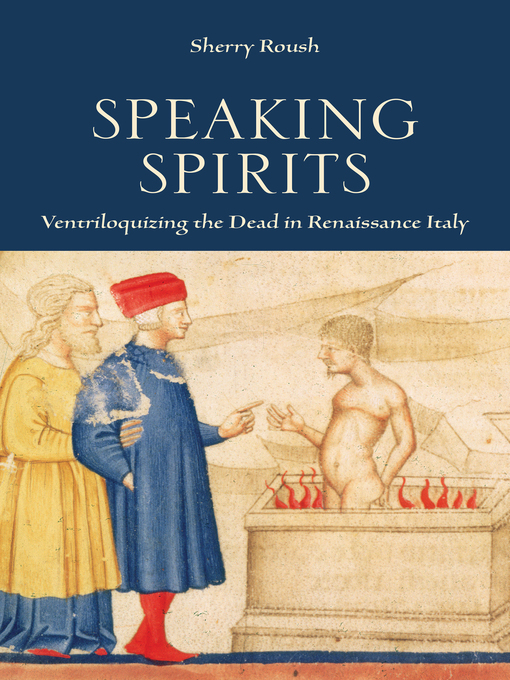
In classical and early modern rhetoric, to write or speak using the voice of a dead individual is known as eidolopoeia . Whether through ghost stories, journeys to another world, or dream visions, Renaissance writers frequently used this rhetorical device not only to co-opt the authority of their predecessors but in order to express partisan or politically dangerous arguments.
In Speaking Spirits , Sherry Roush presents the first systematic study of early modern Italian eidolopoeia . Expanding the study of Renaissance eidolopoeia beyond the well-known cases of the shades in Dante’s Commedia and the spirits of Boccaccio’s De casibus vivorum illustrium , Roush examines many other appearances of famous ghosts – invocations of Boccaccio by Vincenzo Bagli and Jacopo Caviceo, Girolamo Malipiero’s representation of Petrarch in Limbo, and Girolamo Benivieni’s ghostly voice of Pico della Mirandola. Through close readings of these eidolopoetic texts, she illuminates the important role that this rhetoric played in the literary, legal, and political history of Renaissance Italy.
In Speaking Spirits , Sherry Roush presents the first systematic study of early modern Italian eidolopoeia . Expanding the study of Renaissance eidolopoeia beyond the well-known cases of the shades in Dante’s Commedia and the spirits of Boccaccio’s De casibus vivorum illustrium , Roush examines many other appearances of famous ghosts – invocations of Boccaccio by Vincenzo Bagli and Jacopo Caviceo, Girolamo Malipiero’s representation of Petrarch in Limbo, and Girolamo Benivieni’s ghostly voice of Pico della Mirandola. Through close readings of these eidolopoetic texts, she illuminates the important role that this rhetoric played in the literary, legal, and political history of Renaissance Italy.
Alternative filename
lgli/Speaking Spirits Ventriloquizing the Dead in Renaissance Italy (Toronto Italian Studies) [990777].epub
Alternative filename
lgrsnf/Speaking Spirits Ventriloquizing the Dead in Renaissance Italy (Toronto Italian Studies) [990777].epub
Alternative author
Roush, Sherry;
Alternative edition
Toronto Italian studies, Toronto, 2015
Alternative edition
Canada - English Language, Canada
Alternative edition
1, PT, 2015
Alternative edition
1, 2022
Alternative edition
uuuu
Alternative description
In classical and early modern rhetoric, to write or speak using the voice of a dead individual is known as eidolopoeia. Whether through ghost stories, journeys to another world, or dream visions, Renaissance writers frequently used this rhetorical device not only to co-opt the authority of their predecessors but in order to express partisan or politically dangerous arguments. In Speaking Spirits, Sherry Roush presents the first systematic study of early modern Italian eidolopoeia. Expanding the study of Renaissance eidolopoeia beyond the well-known cases of the shades in Dante{u2019}s Commedia and the spirits of Boccaccio{u2019}s De casibus vivorum illustrium, Roush examines many other appearances of famous ghosts {u2013} invocations of Boccaccio by Vincenzo Bagli and Jacopo Caviceo, Girolamo Malipiero{u2019}s representation of Petrarch in Limbo, and Girolamo Benivieni{u2019}s ghostly voice of Pico della Mirandola. Through close readings of these eidolopoetic texts, she illuminates the important role that this rhetoric played in the literary, legal, and political history of Renaissance Italy.
Alternative description
In classical and early modern rhetoric, to write or speak using the voice of a dead individual is known as eidolopoeia. Whether through ghost stories, journeys to another world, or dream visions, Renaissance writers frequently used this rhetorical device not only to co-opt the authority of their predecessors but in order to express partisan or politically dangerous arguments. In Speaking Spirits, Sherry Roush presents the first systematic study of early modern Italian eidolopoeia. Expanding the study of Renaissance eidolopoeia beyond the well-known cases of the shades in Dante's Commedia and the spirits of Boccaccio's De casibus vivorum illustrium, Roush examines many other appearances of famous ghosts - invocations of Boccaccio by Vincenzo Bagli and Jacopo Caviceo, Girolamo Malipiero's representation of Petrarch in Limbo, and Girolamo Benivieni's ghostly voice of Pico della Mirandola. Through close readings of these eidolopoetic texts, she illuminates the important role that this rhetoric played in the literary, legal, and political history of Renaissance Italy. -- From publisher's website
date open sourced
2024-06-09
🚀 Fast downloads
Become a member to support the long-term preservation of books, papers, and more. To show our gratitude for your support, you get fast downloads. ❤️
- Fast Partner Server #1 (recommended)
- Fast Partner Server #2 (recommended)
- Fast Partner Server #3 (recommended)
- Fast Partner Server #4 (recommended)
- Fast Partner Server #5 (recommended)
- Fast Partner Server #6 (recommended)
- Fast Partner Server #7
- Fast Partner Server #8
- Fast Partner Server #9
- Fast Partner Server #10
- Fast Partner Server #11
🐢 Slow downloads
From trusted partners. More information in the FAQ. (might require browser verification — unlimited downloads!)
- Slow Partner Server #1 (slightly faster but with waitlist)
- Slow Partner Server #2 (slightly faster but with waitlist)
- Slow Partner Server #3 (slightly faster but with waitlist)
- Slow Partner Server #4 (slightly faster but with waitlist)
- Slow Partner Server #5 (no waitlist, but can be very slow)
- Slow Partner Server #6 (no waitlist, but can be very slow)
- Slow Partner Server #7 (no waitlist, but can be very slow)
- Slow Partner Server #8 (no waitlist, but can be very slow)
- After downloading: Open in our viewer
All download options have the same file, and should be safe to use. That said, always be cautious when downloading files from the internet, especially from sites external to Anna’s Archive. For example, be sure to keep your devices updated.
External downloads
-
For large files, we recommend using a download manager to prevent interruptions.
Recommended download managers: Motrix -
You will need an ebook or PDF reader to open the file, depending on the file format.
Recommended ebook readers: Anna’s Archive online viewer, ReadEra, and Calibre -
Use online tools to convert between formats.
Recommended conversion tools: CloudConvert and PrintFriendly -
You can send both PDF and EPUB files to your Kindle or Kobo eReader.
Recommended tools: Amazon‘s “Send to Kindle” and djazz‘s “Send to Kobo/Kindle” -
Support authors and libraries
✍️ If you like this and can afford it, consider buying the original, or supporting the authors directly.
📚 If this is available at your local library, consider borrowing it for free there.
Total downloads:
A “file MD5” is a hash that gets computed from the file contents, and is reasonably unique based on that content. All shadow libraries that we have indexed on here primarily use MD5s to identify files.
A file might appear in multiple shadow libraries. For information about the various datasets that we have compiled, see the Datasets page.
For information about this particular file, check out its JSON file. Live/debug JSON version. Live/debug page.