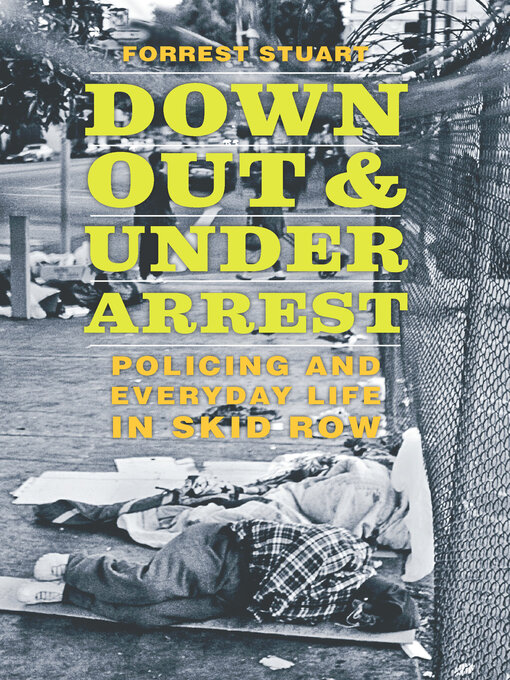
Down, Out, and Under Arrest : Policing and Everyday Life in Skid Row 🔍
Forrest Stuart
The University of Chicago Press, University of Chicago Press, Chicago, 2016
English [en] · PDF · 2.4MB · 2016 · 📘 Book (non-fiction) · 🚀/lgli/lgrs/upload · Save
description
In his first year working in Los Angeles’s Skid Row, Forrest Stuart was stopped on the street by police fourteen times. Usually for doing little more than standing there.
Juliette, a woman he met during that time, has been stopped by police well over one hundred times, arrested upward of sixty times, and has given up more than a year of her life serving week-long jail sentences. Her most common crime? Simply sitting on the sidewalk—an arrestable offense in LA.
Why? What purpose did those arrests serve, for society or for Juliette? How did we reach a point where we’ve cut support for our poorest citizens, yet are spending ever more on policing and prisons? That’s the complicated, maddening story that Stuart tells in Down, Out and Under Arrest , a close-up look at the hows and whys of policing poverty in the contemporary United States. What emerges from Stuart’s years of fieldwork—not only with Skid Row residents, but with the police charged with managing them—is a tragedy built on mistakes and misplaced priorities more than on heroes and villains. He reveals a situation where a lot of people on both sides of this issue are genuinely trying to do the right thing, yet often come up short. Sometimes, in ways that do serious harm.
At a time when distrust between police and the residents of disadvantaged neighborhoods has never been higher, Stuart’s book helps us see where we’ve gone wrong, and what steps we could take to begin to change the lives of our poorest citizens—and ultimately our society itself—for the better.
Juliette, a woman he met during that time, has been stopped by police well over one hundred times, arrested upward of sixty times, and has given up more than a year of her life serving week-long jail sentences. Her most common crime? Simply sitting on the sidewalk—an arrestable offense in LA.
Why? What purpose did those arrests serve, for society or for Juliette? How did we reach a point where we’ve cut support for our poorest citizens, yet are spending ever more on policing and prisons? That’s the complicated, maddening story that Stuart tells in Down, Out and Under Arrest , a close-up look at the hows and whys of policing poverty in the contemporary United States. What emerges from Stuart’s years of fieldwork—not only with Skid Row residents, but with the police charged with managing them—is a tragedy built on mistakes and misplaced priorities more than on heroes and villains. He reveals a situation where a lot of people on both sides of this issue are genuinely trying to do the right thing, yet often come up short. Sometimes, in ways that do serious harm.
At a time when distrust between police and the residents of disadvantaged neighborhoods has never been higher, Stuart’s book helps us see where we’ve gone wrong, and what steps we could take to begin to change the lives of our poorest citizens—and ultimately our society itself—for the better.
Alternative filename
lgli/Forrest Stuart - Down Out and Under Arrest; Policing and Everyday Life in Skid Row.pdf
Alternative filename
lgrsnf/Forrest Stuart - Down Out and Under Arrest; Policing and Everyday Life in Skid Row.pdf
Alternative author
Stuart, Forrest
Alternative edition
United States, United States of America
Alternative edition
Chicago ; London, 2016
Alternative edition
Illustrated, PS, 2016
Alternative edition
Illinois, 2016
Alternative edition
First, 2016
metadata comments
Mobilism
metadata comments
producers:
Adobe PDF Library 15.0
Adobe PDF Library 15.0
metadata comments
Includes bibliographical references and index.
Alternative description
In his first year working in Los Angeles's Skid Row, sociologist Forrest Stuart was stopped on the street by police fourteen times. Usually for doing little more than standing there. Juliette, a woman he met during that time, has been stopped by police well over one hundred times, arrested upward of sixty times, and has given up more than a year of her life serving week-long jail sentences. Her most common crime? Simply sitting on the sidewalk--an arrestable offense in LA. What purpose did those arrests serve, for society or for Juliette? How did we reach a point where we've cut support for our poorest citizens, yet are spending ever more on policing and prisons? That's the complicated, maddening story that Stuart tells in this close-up look at the hows and whys of policing poverty in the contemporary United States. What emerges from Stuart's years of fieldwork--not only with Skid Row residents, but with the police charged with managing them--is a tragedy built on mistakes and misplaced priorities more than on heroes and villains. He reveals a situation where a lot of people on both sides of this issue are genuinely trying to do the right thing, yet often come up short. Sometimes, in ways that do serious harm. At a time when distrust between police and the residents of disadvantaged neighborhoods has never been higher, Stuart's book helps us see where we've gone wrong, and what steps we could take to begin to change the lives of our poorest citizens--and ultimately our society itself--for the better.--From dust jacket. Fixing the poor -- The rise of therapeutic policing -- From rabble management to recovery management -- Becoming copwise -- Training for survival -- Cooling off the block -- Policing the police. Forrest Stuart. Includes bibliographical references and index.
Alternative description
"A well-supported critique of therapeutic policing and, by extension, of similar paternalistic efforts to help the poor by hassling them into good behavior." — Los Angeles Times
In his first year working in Los Angeles's Skid Row, Forrest Stuart was stopped on the street by police fourteen times. Usually for doing little more than standing there.
Juliette, a woman he met during that time, has been stopped by police well over one hundred times, arrested upward of sixty times, and has given up more than a year of her life serving week-long jail sentences. Her most common crime? Simply sitting on the sidewalk—an arrestable offense in LA.
Why? What purpose did those arrests serve, for society or for Juliette? How did we reach a point where we've cut support for our poorest citizens, yet are spending ever more on policing and prisons? That's the complicated, maddening story that Stuart tells in Down, Out & Under Arrest , a close-up look at the hows and whys of policing poverty in the contemporary United States. What emerges from Stuart's years of fieldwork—not only with Skid Row residents, but with the police charged with managing them—is a tragedy built on mistakes and misplaced priorities more than on heroes and villains.
At a time when distrust between police and the residents of disadvantaged neighborhoods has never been higher, Stuart's book helps us see where we've gone wrong, and what steps we could take to begin to change the lives of our poorest citizens—and ultimately our society itself—for the better.
In his first year working in Los Angeles's Skid Row, Forrest Stuart was stopped on the street by police fourteen times. Usually for doing little more than standing there.
Juliette, a woman he met during that time, has been stopped by police well over one hundred times, arrested upward of sixty times, and has given up more than a year of her life serving week-long jail sentences. Her most common crime? Simply sitting on the sidewalk—an arrestable offense in LA.
Why? What purpose did those arrests serve, for society or for Juliette? How did we reach a point where we've cut support for our poorest citizens, yet are spending ever more on policing and prisons? That's the complicated, maddening story that Stuart tells in Down, Out & Under Arrest , a close-up look at the hows and whys of policing poverty in the contemporary United States. What emerges from Stuart's years of fieldwork—not only with Skid Row residents, but with the police charged with managing them—is a tragedy built on mistakes and misplaced priorities more than on heroes and villains.
At a time when distrust between police and the residents of disadvantaged neighborhoods has never been higher, Stuart's book helps us see where we've gone wrong, and what steps we could take to begin to change the lives of our poorest citizens—and ultimately our society itself—for the better.
Alternative description
In his first year working in Los Angeles's Skid Row, Forrest Stuart was stopped on the street by police fourteen times. Usually for doing little more than standing there. Juliette, a woman he met during that time, has been stopped by police well over 100 times, arrested upward of 60 times, and has given up more than a year of her life serving week-long jail sentences. Her most common crime? Simply sitting on the sidewalk an arrestable offense in LA. Why? What purpose did those arrests serve, for society or for Juliette? How did we reach a point where we've cut support for our poorest citizens, yet are spending ever more on policing and prisons? That's the complicated, maddening story that Stuart tells in Down, Out and Under Arrest, a close-up look at the hows and whys of policing poverty in the contemporary United States. What emerges from Stuart's years of fieldwork not only with Skid Row residents, but with the police charged with managing them is a tragedy built on mistakes and misplaced priorities more than on heroes and villains. He reveals a situation where a lot of people on both sides of this issue are genuinely trying to do the right thing, yet often come up short. Sometimes, in ways that do serious harm. At a time when distrust between police and the residents of disadvantaged neighborhoods has never been higher, Stuart's book helps us see where we've gone wrong, and what steps we could take to begin to change the lives of our poorest citizens and ultimately our society itself for the better
Alternative description
Contents 8
Preface 10
Map of Skid Row 13
Introduction 14
Part I: Fixing the Poor 48
1. The Rise of Therapeutic Policing 50
2. From Rabble Management to Recovery Management 91
Part II: Becoming Copwise 136
3. Training for Survival 138
4. Cooling Off the Block 177
5. Policing the Police 218
Conclusion 263
Methodological Appendix: An Inconvenient Ethnography 284
Acknowledgments 304
Notes 310
References 326
Index 338
Preface 10
Map of Skid Row 13
Introduction 14
Part I: Fixing the Poor 48
1. The Rise of Therapeutic Policing 50
2. From Rabble Management to Recovery Management 91
Part II: Becoming Copwise 136
3. Training for Survival 138
4. Cooling Off the Block 177
5. Policing the Police 218
Conclusion 263
Methodological Appendix: An Inconvenient Ethnography 284
Acknowledgments 304
Notes 310
References 326
Index 338
date open sourced
2023-11-03
🚀 Fast downloads
Become a member to support the long-term preservation of books, papers, and more. To show our gratitude for your support, you get fast downloads. ❤️
- Fast Partner Server #1 (recommended)
- Fast Partner Server #2 (recommended)
- Fast Partner Server #3 (recommended)
- Fast Partner Server #4 (recommended)
- Fast Partner Server #5 (recommended)
- Fast Partner Server #6 (recommended)
- Fast Partner Server #7
- Fast Partner Server #8
- Fast Partner Server #9
- Fast Partner Server #10
- Fast Partner Server #11
🐢 Slow downloads
From trusted partners. More information in the FAQ. (might require browser verification — unlimited downloads!)
- Slow Partner Server #1 (slightly faster but with waitlist)
- Slow Partner Server #2 (slightly faster but with waitlist)
- Slow Partner Server #3 (slightly faster but with waitlist)
- Slow Partner Server #4 (slightly faster but with waitlist)
- Slow Partner Server #5 (no waitlist, but can be very slow)
- Slow Partner Server #6 (no waitlist, but can be very slow)
- Slow Partner Server #7 (no waitlist, but can be very slow)
- Slow Partner Server #8 (no waitlist, but can be very slow)
- After downloading: Open in our viewer
All download options have the same file, and should be safe to use. That said, always be cautious when downloading files from the internet, especially from sites external to Anna’s Archive. For example, be sure to keep your devices updated.
External downloads
-
For large files, we recommend using a download manager to prevent interruptions.
Recommended download managers: Motrix -
You will need an ebook or PDF reader to open the file, depending on the file format.
Recommended ebook readers: Anna’s Archive online viewer, ReadEra, and Calibre -
Use online tools to convert between formats.
Recommended conversion tools: CloudConvert and PrintFriendly -
You can send both PDF and EPUB files to your Kindle or Kobo eReader.
Recommended tools: Amazon‘s “Send to Kindle” and djazz‘s “Send to Kobo/Kindle” -
Support authors and libraries
✍️ If you like this and can afford it, consider buying the original, or supporting the authors directly.
📚 If this is available at your local library, consider borrowing it for free there.
Total downloads:
A “file MD5” is a hash that gets computed from the file contents, and is reasonably unique based on that content. All shadow libraries that we have indexed on here primarily use MD5s to identify files.
A file might appear in multiple shadow libraries. For information about the various datasets that we have compiled, see the Datasets page.
For information about this particular file, check out its JSON file. Live/debug JSON version. Live/debug page.